
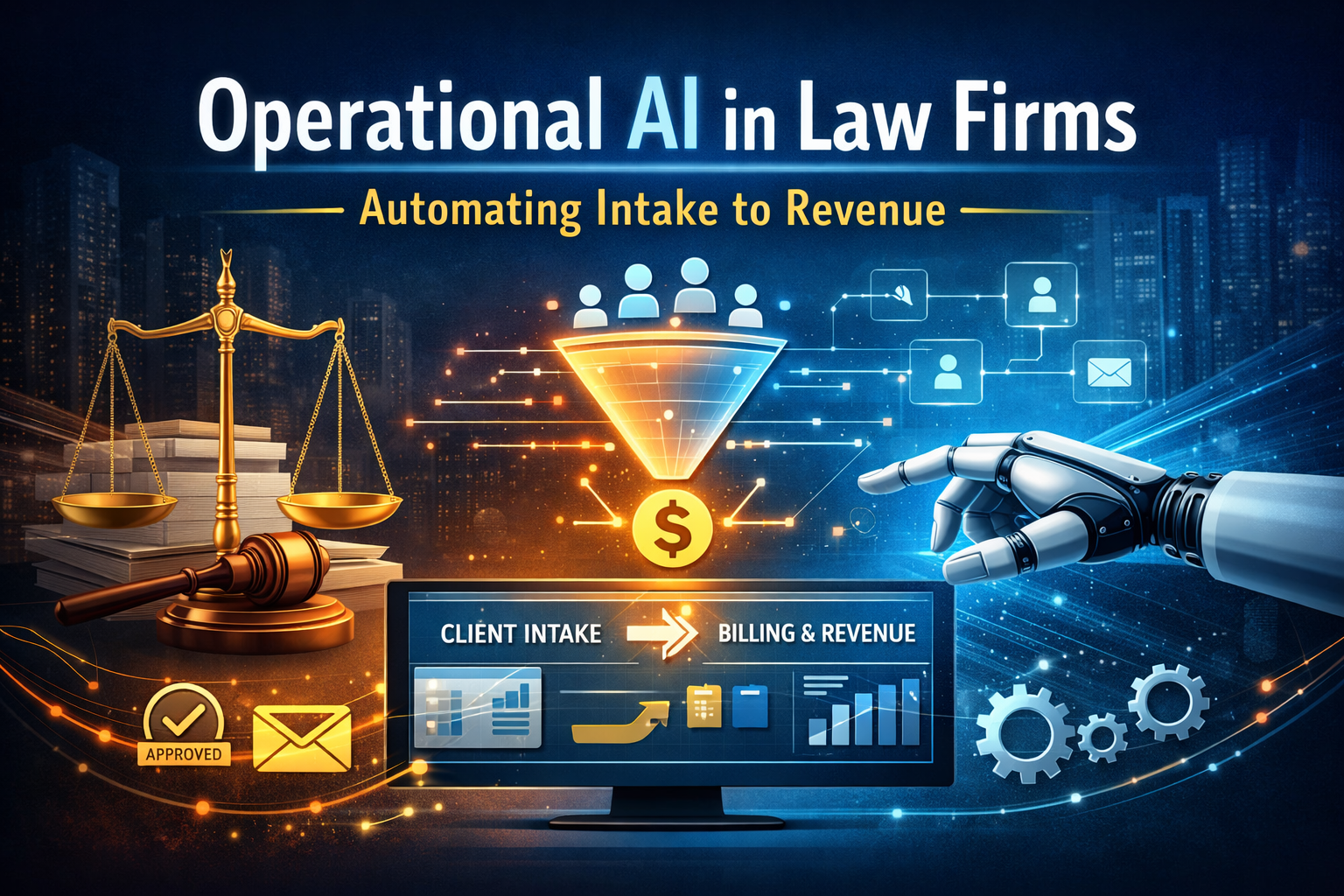
Introduction: AI That Actually Moves the Needle
Law firms don’t lose revenue because they lack AI tools.
They lose revenue because intake breaks before work even begins.
Leads sit unanswered. Follow-ups slip. Conflict checks happen too late. Information is re-entered across systems, creating delays and risk before a matter is even opened.
This is not a technology problem—it’s an operational one.
Operational AI in law firms focuses on fixing these breakdowns by embedding intelligence directly into intake workflows. Instead of assisting individuals, it automates decisions, enforces firm rules, and moves qualified matters from intake to billing without manual handoffs.
When intake runs correctly, revenue follows.
What Is Operational AI in Law Firms?
Operational AI is AI embedded directly into your core business processes, especially intake and matter management.
It works by:
- Applying rules consistently
- Automating decisions, not suggestions
- Triggering actions across systems
- Eliminating manual handoffs
Instead of asking “What should I do next?”, the system already knows—and does it.
Why Intake Is the Highest-ROI Place to Apply AI
Client intake is where revenue begins—or leaks.
Most firms lose potential clients due to:
- Slow response times
- Inconsistent screening
- Manual conflict checks
- Forgotten follow-ups
- Poor handoff from intake to billing
Operational AI fixes this by treating intake as a conversion pipeline, not a form.
How Operational AI Transforms Legal Intake
1. Smart Intake Routing (No Human Bottlenecks)
Operational AI evaluates incoming leads in real time and:
- Classifies practice area
- Flags urgency
- Routes to the correct team
- Applies firm-specific rules automatically
No inbox scanning. No guesswork.
2. Automated Conflict Checks at Intake
Instead of running conflicts after someone reviews the matter, operational AI:
- Checks conflicts as soon as data is entered
- Applies firm-defined conflict rules
- Blocks disqualified matters instantly
- Logs decisions for auditability
This protects the firm before work begins.
3. Rule-Based Follow-Ups That Don’t Slip
Operational AI enforces follow-ups based on logic, not memory:
- If no response in 24 hours → send reminder
- If retainer not signed → trigger escalation
- If intake incomplete → notify intake coordinator
Every lead receives consistent treatment.
4. From Intake to Billing Without Re-Entry
Operational AI connects intake directly to:
- Matter creation
- Rate application
- Billing setup
- Trust requirements
Data flows once—accurately—across the system.
Operational AI vs. “AI Tools” in Intake
| Experimental AI | Operational AI |
|---|---|
| Assists individuals | Runs workflows |
| Suggests actions | Executes actions |
| Lives outside core systems | Embedded in practice management |
| Requires oversight | Enforces rules automatically |
| Low ROI | Measurable revenue impact |
This is the difference between AI as a feature and AI as infrastructure.
Real Business Impact for Law Firms
Firms using operational AI in intake typically see:
- Faster response times
- Higher intake-to-client conversion
- Fewer compliance risks
- Lower administrative overhead
- Cleaner data across matters and billing
Most importantly, partners gain predictability—not just efficiency.
Why Operational AI Is the Future of Legal Operations
As law firms grow, complexity increases:
- More matters
- More staff
- More rules
- More risk
Operational AI scales processes, not headcount.
It ensures your firm runs the same way on its busiest day as it does on its quietest—without burnout or breakdowns.
Frequently Asked Questions
Operational AI automates legal workflows like intake, conflicts, matter creation, and billing using rules and real-time execution.
Operational AI executes processes automatically, while most legal AI tools only assist with isolated tasks.
Intake automation reduces response time, increases conversion, improves compliance, and directly impacts revenue.
Final Thoughts: Don’t Add AI—Operationalize It
The firms that win with AI won’t be the ones experimenting the most.
They’ll be the ones who operationalize it deeply, starting with intake.
Because when intake runs intelligently,
everything downstream runs better.