
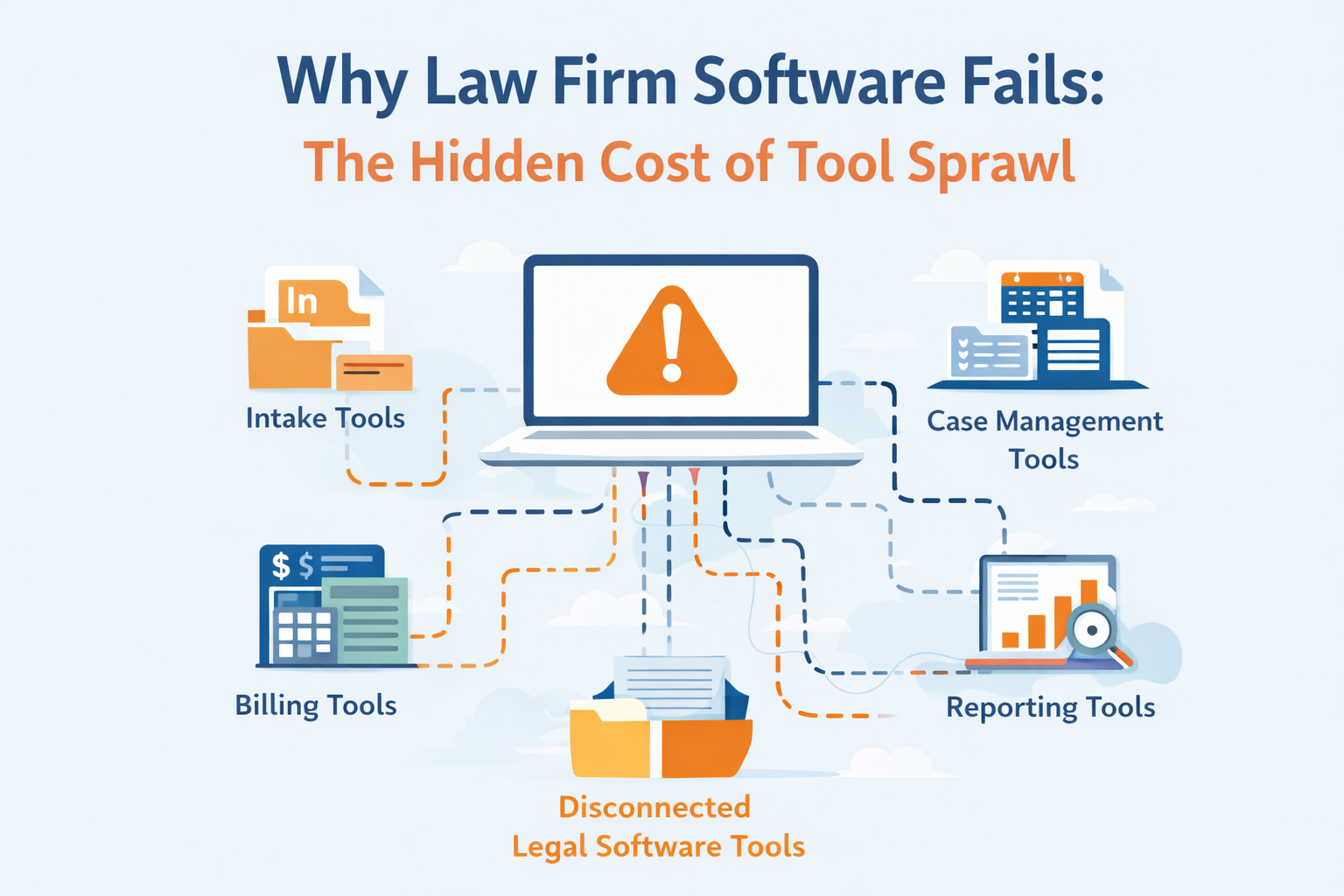
Law firms today have more technology than ever before.
Intake tools.
Billing platforms.
Case management systems.
Document automation.
Analytics dashboards.
And yet, many firms feel slower, not faster.
The issue isn’t that law firms haven’t invested in software.
It’s that they’ve invested in too many disconnected tools.
This problem has a name: tool sprawl — and it’s quietly undermining law firm operations.
What Is Tool Sprawl in Law Firms?
Tool sprawl happens when a firm adopts multiple software solutions to solve individual problems, without considering how they work together.
Common examples include:
- One system for intake
- Another for matter management
- A separate billing and trust platform
- Spreadsheets for reporting
- Email threads filling the gaps in between
Each tool may work well on its own.
But together, they create fragmented workflows and operational friction.
The Real Cost of Tool Sprawl
Tool sprawl doesn’t just increase subscription costs.
It creates hidden operational expenses that compound over time.
1. Duplicate Data Entry
The same client information is entered multiple times across systems.
This increases errors, inconsistencies, and staff fatigue.
2. Training and Adoption Fatigue
Every new tool requires onboarding, documentation, and ongoing support.
Staff end up learning software instead of focusing on client work.
3. Limited Visibility for Leadership
When data lives in silos, leadership can’t easily answer basic questions:
- Where are matters getting stuck?
- Which intake sources convert best?
- What’s driving revenue vs. overhead?
4. Increased Compliance and Risk Exposure
Disconnected systems make it harder to enforce:
- Consistent workflows
- Audit trails
- Trust accounting rules
- Security and access controls
The more tools involved, the harder it is to maintain control.
Why “Best-in-Class” Tools Still Fail
Many firms are sold on the idea of “best-in-class” solutions — choosing the strongest tool for each individual function.
In theory, this sounds ideal.
In practice, it often backfires.
Why?
Because law firm work is process-driven, not task-driven.
When software optimizes isolated tasks instead of end-to-end workflows, firms are left stitching systems together manually — usually with workarounds, spreadsheets, and institutional knowledge.
The result:
- Automation that stops halfway
- Processes that depend on specific people
- Systems that don’t scale as the firm grows
What Modern Law Firms Actually Need
The most efficient firms aren’t using more software.
They’re using fewer, better-connected systems.
Modern law firm software should provide:
- A single source of truth for client and matter data
- Workflow continuity from intake through billing
- Built-in governance and compliance
- Real-time operational visibility
Technology should reduce handoffs — not create new ones.
How to Evaluate Law Firm Software the Right Way
Instead of asking, “Does this tool solve this one problem?”
Law firms should ask:
- Does this software connect intake, matters, and billing?
- Does it reduce manual handoffs between teams?
- Does it improve visibility for leadership and operations?
- Does it scale without adding complexity?
- Does it support compliance by design, not by workaround?
The right platform simplifies operations — even as the firm grows.
Conclusion: Fewer Tools, Better Outcomes
Law firm software doesn’t fail because it lacks features.
It fails because it lacks integration, continuity, and operational clarity.
Reducing tool sprawl isn’t about abandoning technology.
It’s about choosing systems that work together — and support how law firms actually operate.
Fewer tools.
Clearer workflows.
Better outcomes for staff, leadership, and clients alike.