
Introduction: Not All Legal AI Is Created Equal
Artificial intelligence is everywhere in legal tech right now.
Chatbots that summarize documents.
Copilots that draft emails.
Tools that promise instant answers.
Yet many law firms adopt “AI” and see little to no operational improvement.
Why?
Because most firms are investing in experimental AI, when what they actually need is operational AI.
Understanding the difference is critical—especially as AI moves from novelty to infrastructure.
What Is Experimental AI?
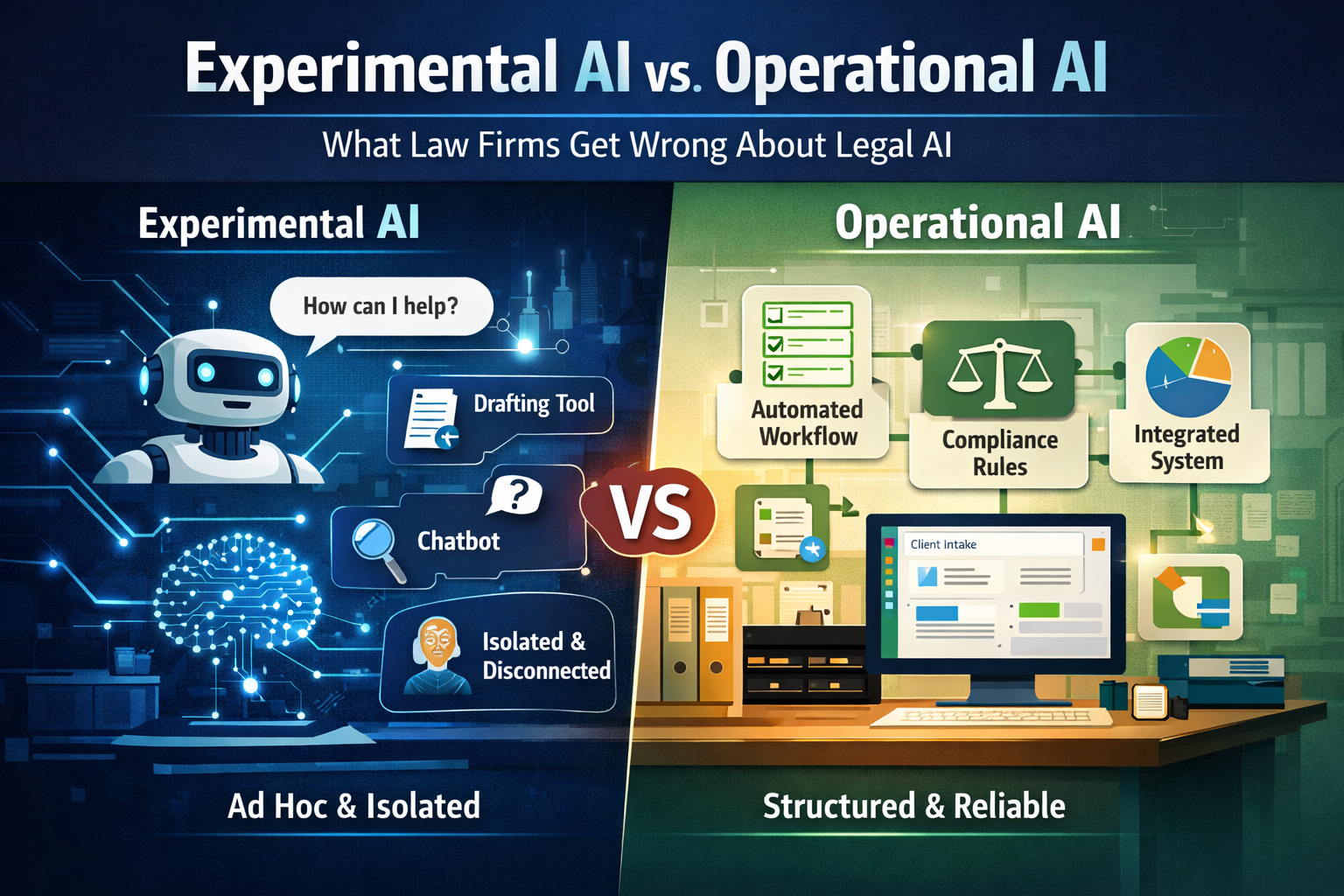
Experimental AI focuses on isolated intelligence.
It usually:
- Lives outside core systems
- Operates on copies of data
- Assists individuals, not workflows
- Produces outputs that still require manual validation
Examples include:
- Standalone chatbots
- Drafting copilots
- Research assistants disconnected from firm data
These tools can be impressive—but they don’t run the firm.
They help people think faster.
They don’t help firms operate better.
Why Experimental AI Falls Short in Law Firms
Law firms don’t struggle because lawyers can’t write fast enough.
They struggle because:
- Intake decisions are inconsistent
- Workflows vary by person
- Documents follow no standard logic
- Billing and trust processes require constant cleanup
- Compliance depends on memory, not systems
Experimental AI doesn’t fix these issues because it can’t enforce structure.
It creates output—but not accountability.
What Is Operational AI?
Operational AI lives inside systems of record.
It doesn’t just generate answers—it executes decisions.
Operational AI:
- Works within defined workflows
- Uses real-time firm data
- Enforces rules consistently
- Triggers actions automatically
- Produces auditable outcomes
Instead of asking,
“What should I do next?”
The system already knows—and acts.
Where Operational AI Actually Matters
Operational AI is most powerful in areas where consistency and accuracy matter more than creativity:
Client Intake
AI helps qualify, route, and prioritize inquiries using firm-defined logic.
Matter Workflows
Tasks, approvals, and timelines follow structured rules—not personal habits.
Document Generation
Documents adapt based on matter data, jurisdiction, and risk—automatically.
Billing & Trust Accounting
AI supports rule-based validation, compliance checks, and exception detection.
Reporting & Visibility
Leadership sees real-time operational truth, not reconciled estimates.
This is AI as infrastructure, not assistance.
Why Systems Matter More Than AI Features
A critical mistake firms make is evaluating AI as a feature checklist.
But AI is only as good as the system it operates within.
Without:
- A single source of truth
- Structured data models
- Defined workflows
- Embedded compliance
AI becomes risky, inconsistent, and hard to trust.
That’s why platforms built on secure, enterprise-grade systems—like Salesforce—are uniquely positioned to support operational AI.
The Shift Law Firms Must Make
The question is no longer:
“Do we have AI?”
The real question is:
“Is AI helping our firm operate the same way every time?”
Firms that succeed with AI:
- Embed it into workflows
- Govern it with rules
- Use it to reduce variance—not create more
- Treat it as operational infrastructure
Firms that don’t remain stuck experimenting—without transformation.
Frequently Asked Questions
Operational AI refers to artificial intelligence embedded directly into a law firm’s core workflows—such as intake, matter management, document generation, and billing—where it executes predefined rules and actions consistently.
Chatbots assist individuals with research or drafting, while operational AI works inside systems of record to enforce workflows, trigger actions, and produce auditable outcomes across the firm.
Experimental AI isn’t inherently risky, but when used without structured systems, governance, and data controls, it can lead to inconsistencies, compliance issues, and unreliable outputs.
Final Thought: AI That Runs the Firm Wins
Experimental AI will always exist—and it has its place.
But the firms that win long-term will be the ones that invest in operational AI:
- Predictable
- Auditable
- Secure
- Scalable
Because in law, consistency beats cleverness.
And AI that runs inside the system—not beside it—is what actually moves firms forward.